

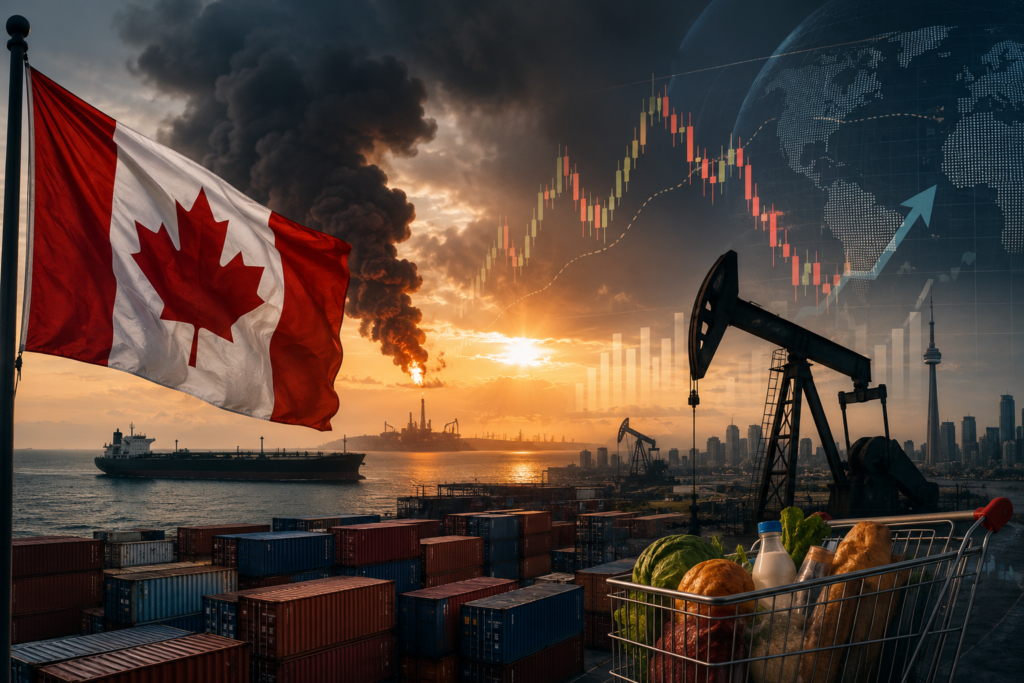
Global events often feel distant from everyday life in Canada, but in today’s interconnected economy, developments on the other side of the world can still influence household budgets, businesses, and financial markets at home.
The ongoing conflict involving the United States and Iran has created uncertainty in global energy markets, prompting many Canadians to ask an important question: how does a conflict thousands of kilometres away affect life here at home?
One of the biggest factors is oil.
The Strait of Hormuz, a major shipping route in the Middle East, carries a significant portion of the world’s oil supply. Any disruption or uncertainty in the region can cause energy prices to fluctuate, and those changes are often felt by consumers across Canada through higher fuel costs. Recent reports have shown that geopolitical tensions in the region have contributed to increased volatility in global oil markets, even as efforts continue to stabilize supply chains and shipping routes.
Higher fuel prices do not only affect drivers at the pump. Transportation plays a major role in moving goods across Canada’s vast geography. When shipping costs rise, businesses may face additional expenses that can eventually influence the prices consumers pay for everyday products, including groceries and household essentials. The Bank of Canada has noted that higher energy prices linked to the conflict are expected to place upward pressure on inflation in the near term.
At the same time, Canada’s position as a major energy producer creates a more complicated economic picture.
Unlike many countries that rely heavily on imported energy, Canada exports significant amounts of oil and natural gas. Higher global oil prices can increase revenues for Canadian energy companies, strengthen government finances, and support economic activity in certain regions, particularly in the West. The federal government’s Spring Economic Update suggests that Canada is somewhat more insulated than many nations because of its role as a net energy exporter.
However, those benefits are not always experienced equally across the country. Families and businesses still face the reality of higher living costs, especially when transportation and energy expenses rise. For many Canadians, the economic effects are less about international markets and more about the price of filling a vehicle, purchasing groceries, or managing monthly expenses.
Looking ahead, economists say much will depend on how the situation develops in the coming months. If tensions continue to ease and global shipping routes remain open, energy prices could gradually stabilize. On the other hand, renewed disruptions or prolonged uncertainty could keep inflation higher for longer and add further pressure to household budgets. The Bank of Canada has indicated that the duration and severity of the conflict will play a major role in determining its long-term impact on Canada’s economy.
For Canadians, the situation serves as another reminder that the modern economy is deeply connected. While Canada is not directly involved in the conflict, events abroad can still create ripple effects at home. As the story continues to unfold, businesses, policymakers, and families alike will be watching closely to see what comes next.